

My Sunscreen Guide + FREE Full Size Gift!

Memorial Day weekend is here, which means 1.) lots of time outside with friends and family, and 2.) plenty of sunscreen! Unfortunately, not all sunscreens are created equal, and some can be incredibly detrimental to your health, especially when considering the health of our children. So, today I'm sharing my updated safe sunscreen guide for you! I'll be discussing the problem with chemical sunscreens, which sunscreens are safe to use, and how to keep you and your kids safe this summer! Before we dive in, starting today through Monday, May 29th, Beautycounter is doing a take your pick FULL SIZE GIFT SET with any $125+ purchase! This means, you can stock up on safe mineral sunscreen and my new favorite lipstick and then choose between a free Multi-Masker Set ($75 value) or the Renew You Body Duo ($59 value). More details below!

Sunscreens are classified as either chemical or physical:
Chemical sunscreens contain one or a combination of different chemical UV filters, such as avobenzone, octisalate, and oxybenzone. Chemical sunscreen act like a sponge and absorb UV rays, and then convert them into heat and release them from the body.
Physical sunscreens—or mineral sunscreens—create a barrier on the surface of the skin to physically bounce or reflect the sun’s rays. The two mineral UV filters are zinc oxide and titanium dioxide.

In 2019, the FDA declared that there is insufficient health and safety data to designate chemical sunscreen filters as safe for use, or GRASE. Their research revealed four of the most common UV filters in chemical sunscreens—avobenzone, oxyzbenzone, octocrylene, and ecamsule—are absorbed by the body in substantial amounts after a single use. In 2020, the FDA released updated testing that revealed chemical UV filters are detectable on the skin and in the bloodstream weeks after application. Blood tests showed concentrations of oxybenzone were more than 180 times the FDA’s level of concern after a single application, and soared to more than 500 times after 4 days of regular use. This is HIGHLY problematic. These are the same active ingredients that are linked to cancer, negative birth outcomes, and endocrine disruption, meaning they can block or alter proper hormone function in the body. Oxybenzone is linked to hormone disruption, negative birth outcomes, reduced male fertility, and possibly cancer. A new study in 2020 linked oxybenzone to DNA damage in breast tissue. It’s also linked to the killing off of coral reefs. In fact, in 2022, it was found that Oxybenzone causes high mortality of coral reefs particularly when exposed to sunlight. Chemical based sunscreens also frequently contain "other ingredients" that are known to be harmful, such as parabens, phthalates, sodium laureth sulfate, fragrance, and retinyl palmitate.


You do not need to go out and purchases a super high SPF sunscreen! An SPF of 100 doesn’t actually give you “double” the protection as SPF 50. SPF 50 blocks about 98% of UVB radiation, and SPF 100 blocks about 99%. People who wear higher SPF actually tend to spend more time in the sun and have a higher risk of getting burned. Even more important to note, SPF only measures protection against UVB radiation. It doesn’t say anything about deeper penetrating UVA radiation, which is linked to aging and may also contribute to skin cancer. Ultimately, choosing a broad spectrum mineral sunscreen that blocks UVA, UVB, and HEV (blue) light is best.

1. Eat foods that provide natural sun protection Foods that are rich in omega-3 fatty acids like salmon, sardines, and eggs have been shown to reduce inflammation, protect cells from free radical damage, and may protect against certain types of skin cancer. Long-term vitamin C intake (along with vitamin E) has been shown to reduce sunburns, and foods high in Vitamin C, specifically citrus fruits, contain compounds that can significantly reduce your risk of skin cancer. 2. Be smart about sun exposure Striking the perfect balance of just enough sun and not too much is tricky business. You want to make sure you're exposing large areas of your skin to the sun on a regular basis so that your skin is able to synthesize the appropriate amount of vitamin D, but you don't want that exposure to lead to a burn. As a general rule of thumb, exposing your skin to about 15 minutes of direct sun a day is enough to provide sufficient vitamin D. 3. Protect yourself with safe mineral sunscreen + UPF clothing The only two active sunscreen ingredients that are currently considered safe are zinc oxide and titanium dioxide (mineral UV filters). Zinc oxide is the only single active ingredient that offers protection from UVA and UVB radiation. Look for a mineral sunscreen that has at least 15% zinc oxide for adequate UVA protection. Reapply every 2 hours, or every time you get out of the water. And while simple enough, wear UPF clothing! Clothing, hats, and coverups are the safest way to protect your skin from the sun!

Countersun - What I use personally for myself and my family. I also use the Daily Sheer Defense For Face SPF 25 which is reinforced with anti-aging properties. No white film! (I use this on my kids.)
Suntegrity Natural Mineral Body Sunscreen - A good option as a body sunscreen. This does leave a slight white film.
Thinkbaby Kids Sunscreen - Best all round sunscreen for kids and baby! This does leave a white film.
All Good Kids Mineral Sunscreen - Another great option for kids! Does leave a white film.

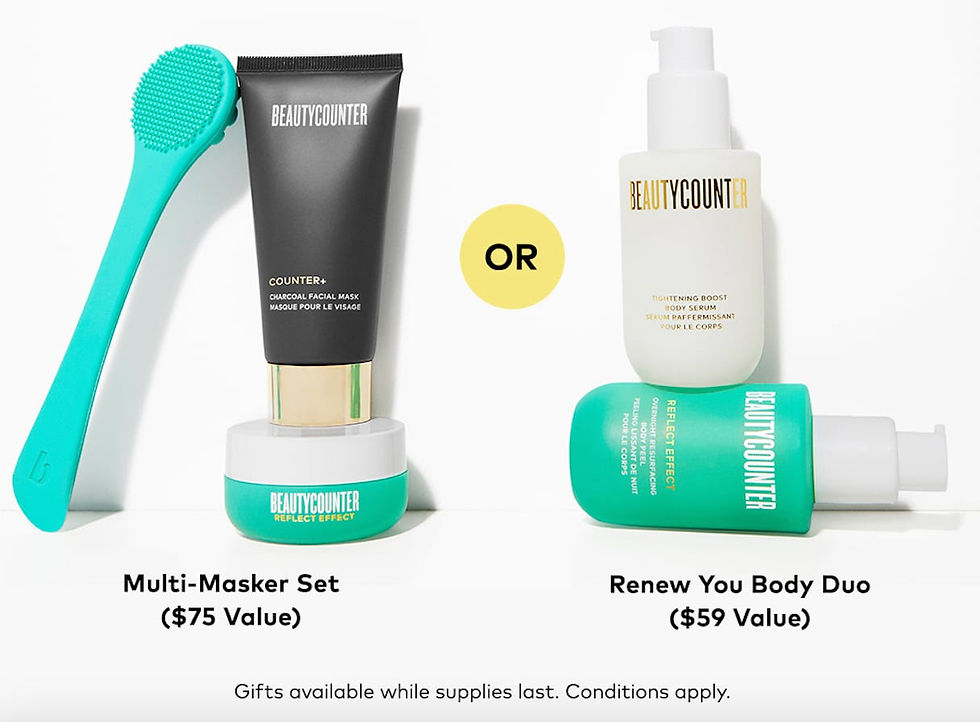
Starting today through Monday, May 29th, Beautycounter is offering a FREE full-sized gift set with a $125+ purchase! Stock up on clean products like this safe, spray mineral sunscreen, and get anti-aging resurfacing acid treatments to get your glow on during the summer!
The Multi-Masker Set contains both the Reflect Effect AHA Mask, plus our breakout reducing Charcoal Mask. This Duo is great for all skin types, and can help to prevent breakouts and resurface and brighten skin. Two things that should be in everyone's toolbox!
The Renew You Body Duo contains our innovative Resurfacing Body Peel, plus the limited edition Tightening Body Serum.
And if you're new to Beautycounter, just use code CLEANFORALL20 for 20% off your purchase. You can also add Band of Beauty to your cart to get a FREE $44+ gift and free shipping for only $19!
Thank you so much for supporting me — it's an honor to have you as part of the wellness community. If you have any questions about what would be right for your skin, comment below or send a message to sagesonder.mp@gmail.com.
Megan Pickup, CNHP, Herbalist
Sage & Sonder
This post may contain affiliate links. Please read our disclosure policy.


Comments